
Engineering Trustworthy Healthcare AI: From Data to Clinical Decisions
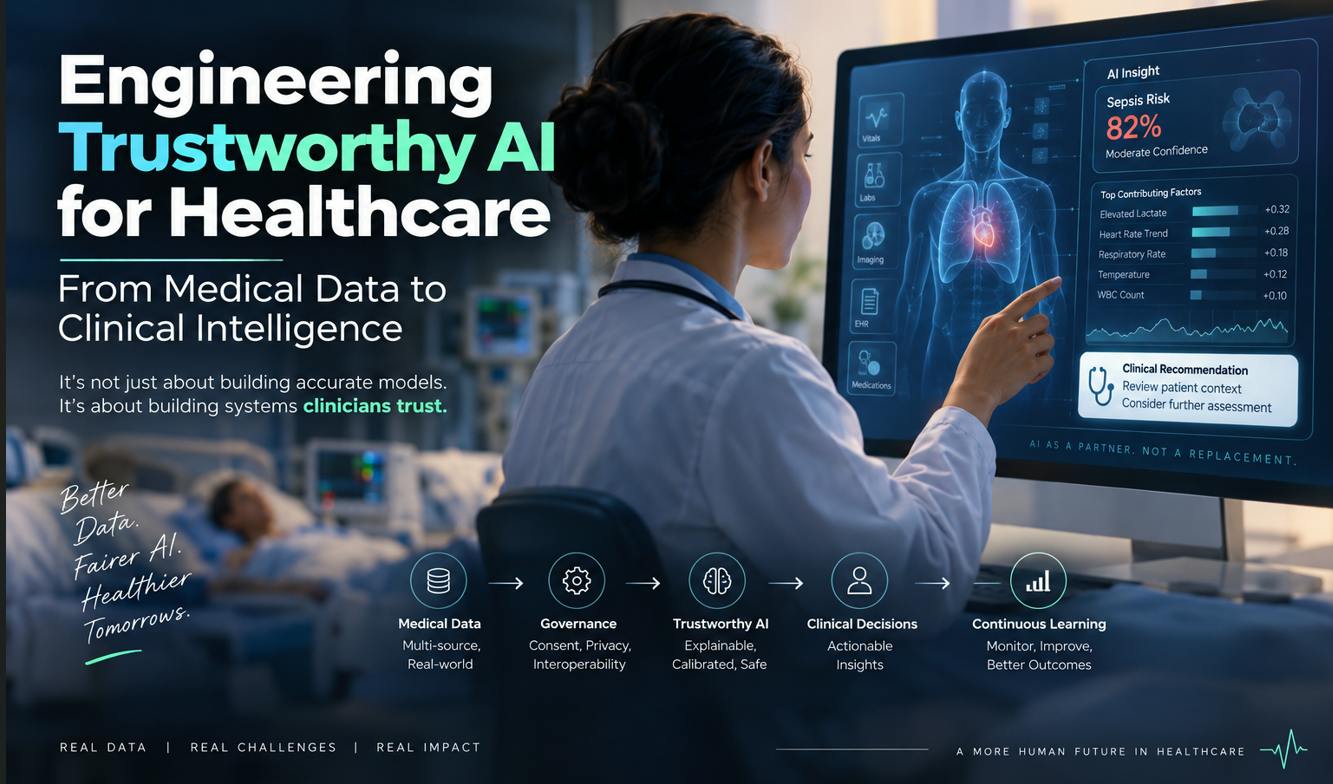
Key Highlights
- Clinical trust in healthcare AI depends on the engineered layer between a model's prediction and a clinician's decision.
- Fragmented records, drifting timestamps, inconsistent units, and unresolved consent constraints can make technically accurate models practically unusable.
- Post-deployment feedback from outcomes, clinician overrides, and drift signals must inform governance and retraining rather than stop at deployment.
Context and Core Dynamics
The account begins with a sepsis prediction model that performed acceptably on paper, with decent AUC and reasonable calibration. Its practical failure emerged during a workflow walkthrough, when an ICU nurse observed that staff no longer looked at the score because it fired too often. The model was technically accurate yet practically useless, because the layer between prediction and decision had not been engineered.
Healthcare data platforms face conditions that are less forgiving than e-commerce or fintech pipelines. A single patient record may be split across an EHR system, a radiology PACS, a laboratory information system that has not been upgraded since 2011, and a scanned PDF faxed from another hospital. Timestamps drift, units of measurement are not standardized, and a mislabeled data point can cause direct harm. Consent is equally architectural: data collected for treatment is not automatically available for model training without a defensible chain of consent and purpose limitation, and teams can discover late that part of a training cohort's consent did not cover secondary use for AI development.
The proposed end-to-end layout treats de-identification, FHIR normalization, lineage tracking, and consent binding as plumbing rather than compliance checkboxes. FHIR helps by forcing a common vocabulary across systems. A feedback loop returns outcomes, clinician overrides, and drift signals to governance and retraining; deployment is a checkpoint, not a finish line.
Caregiving Application and Social Impact
For eldercare, rehabilitation, and specialized care, the implication is that AI supports decisions only when its output is legible and actionable within existing workflows. A prediction that generates frequent, unexplained alerts can displace clinician attention rather than assist it. Architectures that preserve provenance and consent can make monitoring, triage, and care coordination more dependable, while allowing caregivers to see which records informed a recommendation and whether it remains valid.
Ethics and Compliance Note
The ethical boundary is secondary use. Consent must be bound to purpose, de-identification must be verifiable, and lineage must permit retrospective explanation of which records fed which model version. Without those controls, transparency and accountability become claims rather than properties of the system.